With Milosevic gone, what shall the West do?

By Jan Oberg

TFF PressInfo 102 – October 23, 2000

Originally published here.


The Milosevic-West symbiosis

In handling the Balkan crisis the last ten years, the United States and European countries could have chosen a pro-active policy based on conflict analysis and a fair, principled implementation. They could have avoided today’s intellectual, political and moral cul-de-sac and avoided the bombing last year. They would not be de facto protectors of Bosnia and occupiers of Kosovo/a.

Most Western actors grossly underestimated the complexities of the Balkans, they were occupied with the end of the Cold War, they chose to perceive it all in simplified black-and-white terms. They never acted to only help the parties solve their problems, but were guided by their own more or less nationalist, competing interests in the Balkans. And then, above all, there was the “Milosevic factor.”

The West is cosmologically burdened with a tendency to write simplifying, fail-safe recipes for the solution of extremely complex economic, constitutional, historical and structural conflicts: one issue, two parties, decide who is good and who is bad, elevate yourself to judge and solve the conflict by punishing the culprit rather than attack the root cause of the problems that stands between the opponents and the structure around them that made them quarrel.

The name of the game was Milosevic. More than any other single factor the love/hate relationship between him and the West has determined the course of Western conflict-(mis)management this last decade. He was the bad guy par excellence; he was also a man who could – and did – deliver when he had put his signature on a deal; he was the actor who could be blamed for anything that went wrong whether in Croatia, Bosnia, Kosovo or Serbia itself.

When the West recognized that it had lost a decade of perfectly possible violence-prevention in the case of Kosovo and the man also continued to stand up against pressure – and not, in that situation, without support from the citizens of Yugoslavia – it began calling him, for the first time, “cruel dictator.” [Read more…]
Why Milosevic won’t get to the Hague

By Jan Oberg

TFF PressInfo 100 – October 11, 2000

Originally published here.


Western politicians insist that Slobodan Milosevic must be brought to the Hague Tribunal and stand trial as a war criminal. Media and commentators raise the issue time and again. But there are reasons to believe that this is make-believe.

The indictment of Milosevic leaves much to be explained – for instance, why he is indicted only for crimes committed in 1999 but not before – and certain Western countries would hardly want him to be on record in the Hague with a few things that he may know about them.

The West would, therefore, do wise to drop this issue now and let Yugoslavia deal with Milosevic.

It seems that few have bothered to read the text of the indictment of Milosevic and four other high-level government officials of Thursday May 27, 1999. Among other things it states:

“As pointed out by Justice Arbour in her application to Judge Hunt, “this indictment is the first in the history of this Tribunal to charge a Head of State during an on-going armed conflict with the commission of serious violations of international humanitarian law”.

The indictment alleges that, between 1 January and late May 1999, forces under the control of the five accused persecuted the Kosovo Albanian civilian population on political, racial or religious grounds. By the date of the indictment, approximately 740,000 Kosovo Albanians, about one-third of the entire Kosovo Albanian population, had been expelled from Kosovo. Thousands more are believed to be internally displaced. An unknown number of Kosovo Albanians have been killed in the operations by forces of the FRY and Serbia. Specifically, the five indictees are charged with the murder of over 340 persons identified by name in an annex to the indictment.

Each of the accused is charged with three counts of crimes against humanity and one count of violations of the laws or customs of war.”


Limited indictment and dubious facts

As will be seen, Milosevic is indicted for activities limited to the period January 1 and late May 1999, i.e. during the local war between Kosovo-Albanian forces (KLA/UCK) and various Serb/Yugoslav forces and for activities during NATO’s bombings which started on March 24 and went on for 78 days.

At the time the Tribunal could not know any precise facts or numbers. What we do know today from public, reliable sources is that a considerable part of the information about killings and ethnic cleansing was exaggerated or false.

At the time of the indictment, facts could not be verified by independent sources [Read more…]

The Yugoslav nonviolent revolution

By Jan Oberg

TFF PressInfo 99 – October 9, 2000

Originally published here.


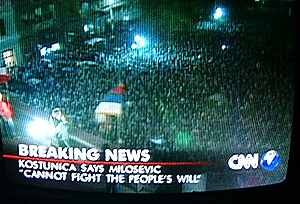
Milosevic certainly did not even think the thought. The opposition had hoped for it but hardly foreseen it would happened just like that. Western leaders and commentators had predicted about everything else but this: that nonviolence by the many would sweep away the authoritarian power presided over and solidified by Slobodan Milosevic over 13 years.

It was a miracle unfolding, minute by minute, in front of our eyes. Unarmed citizens were stronger, finally, than Milosevic’ force.

They also achieved in about 24 hours what NATO violence could not achieve in 78 days. It’s yet another remarkable victory for non-violence. But do we see it like that?


The power of nonviolence

The Shah of Iran lost power mainly due to nonviolent struggle. The Marcos regime in the Philippines did too. Solidarnosc in Poland would not had won had it used violence. The Velvet Revolution in Czechoslovakia is yet another. The East-West bloc confrontation – the “hardest” conflict of modern times, imbued with nuclearism and militarism on both sides – dissolved, not in a nuclear war, as war statistics might have made us expect, but by the remarkable combination of nonviolent forces: the peace and women’s movements in the West and the dissident, human rights and church movements in the East and, of course, the towering figure of Michael Gorbachev who did what no other leader has dared, namely to work his way up to the top of a power system and then declare that it has to be thoroughly changed and that change has to begin here with ourselves, not with “the other.”

These fundamentally important events in contemporary history, like hundreds of smaller changes brought about by non-violence and civil disobedience around the world, have seldom been covered by the media or referred to in history books as victories of nonviolence the way military victories are seen as the result of violence. Nonviolent revolutions like that in Yugoslavia ought to be analyzed as a manifestation of alternative power, not just as a lucky chance.

On Sepember 25, 1999 I participated in the walking demonstrations against the government, arranged by the Alliance for Change in the streets of Belgrade. There were more than 10.000 people, one evening after the other. But it was not enough, it was not broad enough; at the time workers were not actively opposing the Milosevic regime. Opposition politicians were fighting each other while the people marched. But no one present could possibly miss the strength and the determination or the fearless, unrestrained hilarity. [Read more…]

Background on Kosovo – and the management of it*

By Jan Oberg

Manuscript about Kosovo for the World Bank 

26 June 2000


A word about diagnosing conflict

A conflict is a problem that arises out of two or more actors’ incompatible expectations, needs or values. The sine qua non of effective conflict-mitigation (or -transformation) is comprehensive quality analysis of the root causes (diagnosis) of that problem. Without it, interventions to ‘manage’ or help solve somebody else’s conflict and prevent/stop violence will invariable fail – as will surgery on a patient whose disease is unknown to the doctor. You may add that violence is usually not the root cause of a conflict but, rather, a consequence of maltreated, ignored or otherwise non-resolved conflicts.

There is a tendency in Western culture to locate conflict (and violence, but the two are not idenical) in certain actors only. Thus, conflict is often defined as a good guy being attacked or quarelling with an evil guy about one object such as land, rights, resources, etc. Many therefore believe that conflict-resolution is about punishing the designated bad guy, rewarding his counterpart and then things will be fine.

Making “evil” the root cause is much too imprecise to serve as a diagnosis (as it would be to say that a disease is caused by demons in the body). In addition, it begs the philosophical question: What drives humans to do inhuman – evil – things to each other?

This approach is indicative of ‘conflict illiteracy’ – a recipe for failure: Conflicts are not only rooted in individuals (although, of course acted out by and through them) but also in structures in time and space, in circumstances and trends – in the “Karma.” This approach also overlooks that there are never only two parties and that most actors behave as more or less grey, rather than black and white.


The case of Kosovo

So, what’s is the conflict – the problems that lead to the violence – in Kosovo all about?

Having worked there over the 9 years, I would say: it is not predominantly about human rights violations or ethnic cleansing, they are symptoms of deeper lying problems, but – most unfortunately – the only aspects the so-called international community has focussed on hitherto.

As in so many other conflicts there is a history going decades, if not centuries, back in time. There is constitutional matters, general political and specific Yugo-structural features. There is a series of regional dimensions involving neighbouring countries.

And there is economic mal-development. If the GNP of Kosovo is set at 100, Slovenia (1984) had 766, Serbia without Voivodina  and Kosovo 375, Macedonia 249 – and the income gap between the richer and poorer republics and peoples in Tito’s Yugoslavia began to increase rapidly in the 1980s. Structurally more advantaged republics such as Croatia and Slovenia paid considerable parts of their profits to the federal redistribution mechanism, but much of it ended up in corrupted pockets, showplace extravagant public buildings and in land purchases in Macedonia – little left for productive investments in Kosovo.

Depending on the definition, at least 55 per cent of those seeking work were unemployed; illiteracy passed 20 per cent and perhaps as many as 400,000 kids were out of the regular schools; over 40 per cent of the people had no access to tap water, only 28 per cent lived in areas with a sewage system.

Kosovo had the highest birth rate and the highest infant mortality rate in Europe; more than 50 per cent of the citizens were below 20, the average age being 24 years of age. Albanians made up 67 per cent of the population in the province in 1961 (they also lived elsewhere in former Yugoslavia, some sources say 100.000 in Belgrade alone), they appear to have risen to about 90 per cent in the 1990s.  [Read more…]

Prevent violence in Montenegro

By Jan Oberg and Soren Sommelius

TFF PressInfo 91 – April 7, 2000

Originally published here.


“A fifth war in the Balkans can still be prevented. But whereas the isolated leadership in Belgrade has plenty of time, Montenegro does not, and the international community is so bogged down in Bosnia and in Kosovo that it has little capacity to shape an effective violence-prevention strategy for this tiny republic of 635.000 inhabitants.

What we just heard during our fact-finding mission to Podgorica,” say Soren Sommelius and Jan Oberg of the TFF conflict-mitigation team, “was frighteningly similar to what people told us in Croatia in 1991 – in spite of all the differences between the two cases.”

Picture series from Montenegro

“It was a bit surprising to listen to the level of verbal aggression in Podgorica not only against Milosevic, but also against the Serb people and the opposition and even the federal constitution that the Republic signed as late as 1992 when a) it was fully aware of who Slobodan Milosevic was, and b) had participated in the wars elsewhere as part of the JNA, the Federal Yugoslav Army. It could hardly be argued that people in Montenegro did not know who or what they federalized with.

Violence-preventive diplomacy by everyone is dearly needed now. Patience and longterm policy for the Balkans as a whole, and implemented with utmost caution, will be essential. Unfortunately, the international community’s policy in the region up till now is not exactly helpful to Montenegro, whichever way it chooses,” state Sommelius and Oberg.


THE BACKGROUND AND THE GAME

In contrast to other Balkan conflicts, this one can not be acted out through ethnicity or religion. A ‘real’ Serb has Montenegrin roots and there are probably more people of Montenegrin origin in Serbia than Montenegrins in Montenegro where 62 % are Montenegrins, 9 % are Serbs, 14 % are Muslims and 7% are Albanians (1991 census). [Read more…]

Misguided motives led to the chaos in Kosovo

By Jan Oberg

April 5, 2000 – on CNN Interactive

(CNN) — The conflicts that led to war and dissolution of the former Yugoslavia took shape in the 1970s and early 1980s, and their origins are much older. The paradox is that the international community’s self-appointed “conflict managers” have not treated the Balkan conflicts as conflicts.

Instead, they have wielded power and practiced Realpolitik disguised as peacemaking and humanitarianism.

The international community — a euphemism for a handful of top leaders – has historically been an integral party to the conflicts, not an impartial mediator. A policy of disinterested conflict analysis, mediation and conflict resolution would require different analyses, means and institutions (with just a minimum of training).

The leaders of the republics of the former Yugoslavia all did their best to destroy the federation from within. Today’s situation, however, is equally the result of the international community’s failed conflict management in four cases – Croatia, Bosnia-Herzegovina, Macedonia and Kosovo.

None of the peace agreements work as expected. The regions are more polarized and ethnically cleansed than before. Democracy is formal and imposed, not genuine. The countries are not armed simply for defense, they are militarized.

War criminals are still at large. Refugees have not returned in any significant numbers (except to Kosovo). The deeply human dimensions of tolerance, forgiveness, reconciliation and societal regeneration have hardly begun. No commissions on truth or history have been established.

Money – always plentiful for military purposes – is conspicuously lacking for the prevention of civilian violence and for postwar development. Integration into the EU may not take place for a long time yet.

Finally, and fatally, the U.N. missions to these countries have been thrown out, substituted with more expensive and heavy-handed missions, or discontinued prematurely.  [Read more…]

The UN broke in Kosovo – Not even Nordic governments seem to care

By Jan Oberg

TFF PressInfo 86 – February 7, 2000

Originally published here.


“Isn’t it amazing that the new moralists who profess to protect human rights, democracy and peace and who spent unlimited funds on warfare now don’t even bother to provide the UN with the minimum funds to bring peace to Kosovo?

The UN urgently needs US$ 102 million. That equals what Sweden spent on sending 860 soldiers to Kosovo. This is what the United Nations Foundation “UN Wire” reported on February 3, 2000 – about a year after the Rambouillet “peace” process began. It is yet another proof of the inter-cynical community’s mode of operation,” says Jan Oberg.

– – – – – –

“UNMIK Out Of Money, Kouchner Says.”

The United Nations has no money to pay its civil servants in Kosovo, UN administrator Bernard Kouchner said today. Speaking to reporters at the Japan Press Club in Tokyo, Kouchner said the UN Mission in Kosovo (UNMIK) is “facing an emergency, period. We have to pay the civil servants.” Some workers, Kouchner added, have not been paid for months, and “there is 0.00 deutsche mark in the budget 2000 of Kosovo”…Kouchner said the UN needs $102 million for its operation.

“It is the first time in the history of United Nations peacekeeping operations that we have to deal with a budget, with the payment of the civil servants and organise an administration,” Kouchner said. “It is why it is so important to get not only promises, but cash. For the infrastructure projects, we can wait a little bit longer but not for the payment of the civil servants. We must pay them.”

Last week, US Secretary of State Madeleine Albright criticised the international community for failing to live up to its financial commitment to Kosovo. “Unfortunately, a serious crisis of funding has arisen,” she said. The United States, Albright added, would contribute an additional $10 million and 100 police officers for the operation.” And: [Read more…]

The West and conflicts in and around Yugoslavia: Some axioms

By Johan Galtung

Presumably written in 2000

[1]  Europe is divided since 1054 (forerunner 395) and 1095 into three parts: Roman-Germanic/Catholic-Protestant (+USA = the West); Slavic-Orthodox and Turko-Muslim.  Romania, Greece: ambiguous.

General archetype: Slavic/Orthodox, and Turko/Muslim, are evil.

[2]  Faultlines intersect in Sarajevo/BiH; cut Pristina/Skopje.

[3]  Parties are nations with claims on land with dualism of discourses as bondage versus independence.  Living together only under foreign rule (Habsburg/Ottoman; Nazi; Tito; NATO).  [Read more…]

Preventing Peace – New TFF report

By Jan Oberg

TFF PressInfo 82 – December 16, 1999

Originally published here.


“We are seeing it for the umteenth time in international conflict-management: when intellectual analysis and politics fall apart, cover it up with military potency and give it all a human face!

One would like to believe that the West’s moral, legal and political conflict ‘management’ disaster in the Balkans and in Kosovo 1989-1999 would be debated throughout the West – democracies with freedom of speech.

The silence about that failure, however, is roaring. It’s just the locals who won’t understand how well-meaning we were and are!

But something else is happening: the disaster is turning into a recipe! Read the statements from leading ministers, top generals, EU, and NATO during the last six months. They invariably state ‘that we have learnt in Kosovo’ that we need more military capacity, more force. NATO’s Secretary- General, Lord Robertson, tells the world that “the time for a peace dividend is over because there is no permanent peace – in Europe, or elsewhere. If NATO is to do its job of protecting future generations, we can no longer expect to have security on the cheap.” Well, Lord Robertson is of course constitutionally prevented from pondering what world leaders have done so miserably the last ten years since the century ends under such dark clouds. [Read more…]

Misleading UN Report on Kosovo (B)

By Jan Oberg

TFF PressInfo 78 – October 3, 1999

Originally published here.


“The UN and NATO missions in Kosovo violate Security Council Resolution 1244 which clearly guarantees the sovereignty and the territorial integrity of the Federal Republic of Yugoslavia (FRY). The Security Council has just reaffirmed that Kosovo is a part of FRY. 1244 also demands the full cooperation of FRY in implementing the missions tasks. All this is pure pretence, as any visitor to Kosovo will learn – and mission members will tell you privately.

The Report of the Secretary-General (S/1999/987 of September 16) does not even bother to mention whether KFOR/UNMIK cooperates with Belgrade! It seems pretty clear, rather, that the international community has fooled Belgrade and considers it so weak that it doesn’t even have to be polite or give the world the impression that it respects the country’s sovereignty. This coincides with credible press analyses that the U.S. decision makers think Kosovo must become independent.

The international presence of UNMIK and NATO in Kosovo base itself on the bombing campaign the legality of which remains highly disputable. In its day-to-day operations, this presence amounts to a de facto occupation force that co-operates with Albania military and civilian leaders who have perpetrated gross human rights violations,” says Jan Oberg upon his return from Pristina, Skopje and Belgrade, TFF’s 37 mission to the region.

Here follow some facts:

“The missions have set up border points to Serbia but until recently not to Macedonia and Albania. Public and state property is ‘taken over’ by the UN and KFOR, no legal regulations done or rent or compensation paid to the Yugoslav state. Visa is not needed to enter Kosovo. The German Mark is introduced and the Yugoslav dinar disappearing. Tax and customs are now collected to the benefit of Kosovo, with no proportion going to Serbia or Yugoslavia. A new army-like “Kosovo Protection/Defence Force” is established and has the old KLA commander at its head.

Should we be surprised if the mineral resources and the Trpca mining industry complex in Mitrovica is soon ‘taken over’ by foreign capital? Dr. Kouchner serves at the moment as a one-man legislature: he can overrule any federal law and he promulgates legally binding “regulations” by the day.

Resolution 1244 stipulates that ‘after the withdrawal an agreed number of Yugoslav and Serb military and police personnel will be permitted to return to Kosovo to perform functions’ such as liaising with the international civil and military missions, marking and clearing mine fields, maintaining a presence at Serb patrimonial sites and maintain a presence at key border crossings (specified in Annex 2). Reference to all this is conveniently omitted in the UN Report – that serves to evaluate the UN mission and is written, we must assume, by the UN staff in Pristina itself.

So much for the United Nations manifest, gross violation of FRY’s sovereignty and territorial integrity. One understands why all this goes unmentioned in the Report. I am not a lawyer, but it looks to me as a new sort of international lawlessness and might-makes-right,” says Jan Oberg. [Read more…]

Misleading UN report on Kosovo (A)

By Jan Oberg

TFF PressInfo 77 – October 3, 1999

Originally published here


“Those who wrote the Report of the UN Secretary-General on the UN Mission in Kosovo (UNMIK) must have had other aims than accurate reporting. The report is biased, embellished, slanted. It omits important aspects which point toward the fact that this mission ignores Security Council Resolution 1244 on which it is based and is a failure in-the-making on its own criteria,” says TFF director Jan Oberg upon his return from TFF’s 37th mission to the region and his visit to Pristina, Skopje and Belgrade.

“The report (S/1999/987 of September 16) covers the period in which at least 150.000 legitimate non-Albanian (Serbs, Roma,etc) citizens were driven out of the province. Normally this would be called ethnic cleansing. It has happened under the very eyes of 45.000 NATO soldiers, 1.100 UN civilian police and thousands of other internationals, including the OSCE and EU.

The report does not state that this is a fatal blow to both NATO and the UN. Res. 1244 states that the mission is to ‘ensure conditions for a peaceful and normal life for all inhabitants of Kosovo’ as well as, among many other things, maintain law and order, protect and promote human rights and ensure public safety. The report states that ‘KFOR deserves great credit for its efforts…’

I do not think it does,” says Oberg. “The international community condemned Yugoslavia for having, at the height of the war and bombing, about 40.000 soldiers and police in the province to maintain law and order and – as they saw it – to protect the Serb and other minorities. Now the total international presence is almost twice as big and it has not been able to fulfil the centre-piece of the UN mandate: to preserve a multiethnic Kosovo in safety for everybody.

For all practical purposes, Kosovo has been ethnically cleansed by the KLA and other Albanians after the international community arrived. This is neither regretted nor condemned in the report. Rather, the report states [Read more…]

NATO’s psychological projection

By Jan Oberg

TFF PressInfo 75 – July 30, 1999

Originally published here.

Serbo-Croatian version here.


“I believe there were overlooked or suppressed dimensions such as collective psychology, deep cultural codes and domain Western expansionist/missionary values at work in the West’s handling of Kosovo, and I think we do wise to discuss them.

For instance, does the US-led West in fact hide a latent, deep-seated authoritarian ideology that seeks world dominance while pretending to create global democracy, partnership and multiculturalism? And does it in its own manner – like Milosevic and Hitler in their different manners – thrive on somebody else’s crisis while pretending to help them?

It is fascinating to see how quickly the public, the politico-diplomatic discourse and the media have managed to relegate the crisis, this turning point in contemporary history, to the past. But what has happened in, and to, the West itself during the Balkan wars and during Kosovo in particular deserves a bit of introspection – and perhaps we won’t like what we see if we try,” says TFF director Jan Oberg.

“Norwegian-Swedish philosopher Harald Ofstad 30 years ago analysed the ideology of Nazism. He maintains that Nazism builds on and is an extreme version of Western values, of its ‘Weltanschauung.’ Its main feature is ‘our contempt for weakness’ and a celebration of strength, power and heroism. The Strong SHALL rule over the Weaker. The good/stronger has a right, or God-given authority, to control or eradicate the evil/weaker who only deserves our contempt. The stronger takes upon him a burden of civilisation, sacrifices and acts heroically in the name of a higher principle or ‘law’, of Good.

Thus he is never made responsible for his deeds; he has a higher mandate and is above common law. Those carrying out the leader’s orders are conveniently also relieved from responsibility, no matter how criminal they may be – since they too aim to drive out Evil and (re)install Good. Anti-semitism is not essential to the authoritarianism of the Nazi worldview, rather just a flawed, perverted element in it. [Read more…]

Some ethical aspects on NATO’s intervention in Kosovo – Part B

By Jan Oberg

TFF PressInfo 74 – July 29, 1999

Originally published here.

Serbo-Croatian version here.


• Stereotyping and discrimination
Ask yourself whether NATO’s bombing and subsequent occupation could have been done against any other nation in today’s Europe. Whether any other country than Yugoslavia and any other people but Serbs is so despised? The plight of the Albanian refugees is in focus, but how well and how extensive did media cover that of the Serbs, Goranis, Montenegrin, Turks and Gypsies in Kosovo? The refugee camps in Macedonia and Albania entered our living rooms – but did the human suffering of people living in and fleeing to bombed-out Yugoslavia?

Recent Albanian extremist violence against Serbs is reported with ‘understanding,’ presented as (justifiable) revenge for what Serb police, military and paramilitary units did. But the media which told the story this way, never ‘explained’ that Serb ethnic cleansing after NATO started bombing could be ‘understood’ as (justifiable) anger at what THEY saw as the destruction of their entire country commissioned or demanded – as it was – by moderate as well as extremist Kosovo-Albanians.

Everybody knows that humanitarian aid should be based on needs only. But people living in Yugoslavia shall not receive any assistance ‘as long as Milosevic is at the helmet.’ One wonders whether the international human rights community is on collective holiday? Since the early 1990s, Serb human and minority rights were never cared for to the extent e.g. Croatian, Bosniak and Albanian rights were.

In social science, stereotyping can be defined as ‘a one-sided, exaggerated and normally prejudicial view of a group, tribe or class of people, and is usually associated with racism and sexism.’ Stereotypes are often resistant to change or correction from countervailing evidence, because they create a sense of social solidarity. Is it so unlikely that the United States and NATO did just a bit of stereotyping to maintain alliance credibility and solidarity?

• Authoritarian politics undermining international democracy.
NATO now has a near-monopoly on conflict-management. The UN, the EU, single governments in the region, OSCE and NGOs went out of the region when NATO went in. No NATO government declared war, no parliaments voted about participation in the campaign. (In contrast, the ‘dictatorship’s parliament in Belgrade debated both the Rambouillet and the G8 plan). None of the democracies in NATO dared challenge the near-total US military and political dominance in this operation or that of the “Quint” – the five biggest NATO leaders. [Read more…]

Some ethical aspects on NATO’s intervention in Kosovo – Part A

By Jan Oberg

TFF PressInfo 73 – July 14, 1999

Originally published here.

Serbo-Croatian version here.


“Now is the time to begin to reflect on what actually happened this spring in Kosovo and, thus, to the world. I believe that historians will agree that from March 24, 1999 international politics and relations as well as the global system has changed in a deep sense,” says TFF director Jan Oberg.

“Many consider NATO’s intervention a moral success, a just war, a victory for democratic values.

But I believe we need to look at it from a variety of angles to a) understand it more deeply and b) to work out ideas, concepts and policies so that anything similar will never happen again elsewhere. It is indeed peculiar that this war – conducted from a moral high ground and with the aim to promote the finest ideals of Western culture – has hardly been evaluated in just such terms. I am not a philosopher of ethics, but here are some points you may use in your own thinking about contemporary history and – if it exists – ‘moral foreign policy.’

• A high-ideals, low-risk war
The West has man and noble ideals. But when it comes to risking Western lives for them, they crumble. Both Albanians and Serbs have proved themselves willing to pay a price for what they believe in.

• David and Goliath
World history’s most powerful alliance attacks a small state, devastates it with 1100 planes during 79 days. NATO could do anything in Yugoslavia, but Yugoslavia had no capacity to hurt any NATO country. Whatever propensity to feel sympathy for David there may be in Christian values, it didn’t surface. Explanation? Ten years of demonization. In addition, cruise missiles are low-cost and promise destruction on the enemy’s territory without human or material costs on our side. Behind NATO’s boasting of success and determination hides a high-tech-based cowardice second to none. [Read more…]

NATO in Kosovo – Failed peacekeeping

By Jan Oberg

TFF PressInfo 72 – June 18, 1999

Originally published here.

Serbo-Croatian version here.


“If a UN operation had gone this wrong from the beginning, if the mandate had been violated to this extent, politicians, diplomats and media worldwide would have cried ‘Failure!’

But since it is a US-lead NATO operation, independent-minded evaluations and criticism is conspicuously absent from mainstream media and the political discourse. The homogenisation of public opinion with NATO propaganda throughout the Western democracies is disheartening,” says TFF director, Dr Jan Oberg.


1. THE NATO DOG WILL WAG THE UN TAIL

While NATO troops have been in Macedonia the last 8 months, only on June 14 could the UN Secretary-General Kofi Annan present a plan for a civil UN administration for Kosova. It puts the EU in charge of reconstruction and gives the OSCE primary responsibility for establishing democratic institutions, organising elections, and monitoring human rights. The UNHCR will take charge of the resettlement of refugees and displaced persons.

The UN Interim Administration Mission in Kosovo (UNMIK) will administer the police, justice, schools, public transport, telecommunications, and power plants. An international police unit of up to 2,000 will oversee the establishment of a Kosova police force. On 12 June, Annan appointed UN Undersecretary-General Sergio Vieira de Mello of Brazil as interim – interim! – special representative.

SC Resolution 1244 consistently mentions “the rapid early deployment of effective civil and security presences” and consistently mentions the two components simultaneously. Reality on the ground is already totally different. Evident for everyone who wants to see, the NATO dog will wag the UN tail as it pleases, in time and in space. And it will take months before the civilians are in place and co-functioning. Remember that it took 5-6 months to get the former OSCE KVM mission of 1200 deployed – only to be forced out due to NATO’s bombing plan.

This is catastrophic. Precisely in this type of conflict, the need for social, village-based security provided by civil police and what the UN used to call ‘Civil Affairs’ staff is absolutely essential. While NATO is simply not trained for this or has any experience in it, the UN an OSCE and civilian NGOs everywhere have.

[Read more…]