Forums for human rights and peace education in Eastern Slavonia – and elsewhere

By Jan Oberg

October 11, 1998

Originally published here.

“This is a modest proposal for institutionalisation of peace-related teaching in regions of conflict. It’s a Citizens Forum for Human Rights and Peace Education, HR&PE. It mentions Croatia but is equally relevant for, let’s say, Kosovo or Macedonia, or any other trouble spot. You may think that this is relevant only after war, but I strongly believe that forums like this should be created wherever the situation threatens to erupt into violence. If the trigger-happy international “community” had invested in such projects – both in their own ministries of foreign affairs, in international organisations and in trouble spots such as Kosovo – 5 or 10 years ago, people on all sides would begin to realise the utter futility of using weapons to achieve their goals,” says TFF director Jan Oberg.

“You see, there are no limits to what can be done to help people coexist in postwar communities. The international community has no specialised competence or organisations in this field. Post-war reconciliation is the most important measure to prevent future outbreaks of violence – and we must focus particularly on children and youth,” says TFF director Jan Oberg.

“TFF has been working for more than one year with reconciliation issues in Eastern Slavonia, Croatia. We have analysed problems of co-operation in many schools, served as resource persons at three UN/Council of Europe seminars for principals and teachers, helped about 120 Croat and Serb gymnasium students to see a better future together and we’ve supported local Serb media in their wish to contribute to reconciliation. Just a couple of weeks ago, TFF conducted a seminar with CINES – the Citizens Initiative Network Eastern Slavonia that we helped create in June, an effort to bring mixed groups of teachers, media people and all NGOs together as they are all educators.” [Read more…]
Questions before bombing Serbia

By Jan Oberg

TFF PressInfo 47 – October 1, 1998

Originally published here


“What on earth would be the POLITICAL AIM of bombing Serbia now? Violence has been used by both parties for almost a year. Some 250.000 people may already be displaced, homes and towns torched and destroyed. KLA is defeated and Serbia’s government has declared that the war is over, provided KLA’s military struggle does not resume.

Before the UN Security Council, NATO or other actors in the international ‘community’ decides to carry out air strikes throughout Serbia, it would be wise to ponder a few questions, problems and risks and come up with some answers. I offer some of both in what follows,” says Jan Oberg who, with his TFF colleagues, has conducted analyses and served as a citizen diplomat in the region since 1992.


• IF WE BELIEVE NATO MILITARY INTERVENTIONS WOULD STOP THE KILLING, ETHNIC CLEANSING AND MASSACRES, WHY HAS IT NOT HAPPENED LONG AGO?
POSSIBLE ANSWERS: 
1) The international “community” is not a community when it comes to managing conflicts. There are too many solid national interests and the EU is divided internally with Germany and the UK being more interventionist than the rest. And they cannot act without the United States. 2) Bombings of Serb facilities will unavoidably be interpreted as a support to (violent) secessionism. Thus, Kurds, Palestinians, Turk Cypriots, people in the Basque province and in Chechenya, to mention some, may be encouraged – and the West doesn’t exactly want that. 3) It can’t be done without ignoring the Russians – but they are on their heels anyhow. 4) Perhaps no bombings is really contemplated; it’s all a game. But then there is a public relation problem vis-a-vis citizens: why do statesmen solemnly declare their moral outrage, threaten tough measures and thereby create expectations worldwide about resolute action – fully well knowing that they won’t do anything? 5) Powerful actors may see it fit to wait and “fail” with preventive diplomacy in order to present military options as “necessary.”


• IS THIS COMPATIBLE WITH INTERNATIONAL LAW?
POSSIBLE ANSWERS: 
1) It is probably the first time NATO bombs a sovereign, recognised state in support of a movement whose stated aims are complete independence and integration with a neighbouring state. 2) Bombings would [Read more…]

Human rights in Kosovo/a – Not so simple

By Jan Oberg

TFF PressInfo 45 – August 27, 1998

Originally published here.

“To understand a conflict – and, thus, help solve it – we need to know something about at least three things: Attitudes, Behaviour and the root Causes of the conflict. That’s the ABC. Most media simply report on behaviour and ignore the two other dimensions. This is why people in general feel that they don’t understand much of it all, in spite of watching and listening carefully to news reports. And when media cover conflict behaviour, many seem to use the KISS principle – Keep It Simple, Stupid. What you have heard about human rights in Kosovo/a is a good example of KISS journalism,” says Jan Oberg, head of TFF’s Conflict-Mitigation team upon returning from yet another mission to Belgrade, Prishtina and Skopje.

“I want to make it clear that I consider the Serb government guilty of extremely serious and systematic human rights violations in the Kosovo province. Over the years, the Serb leadership has pursued an absolutely immoral and self-defeating policy of repression. Having listened to hundreds of personal accounts of human rights violations, I know that. Numerous human rights organisations offer overwhelming documentation.

During our missions, TFF’s team has been stopped repeatedly on the roads, interrogated at police stations for hours, and deprived of written Albanian materials. I have seen the blood on the sidewalk after a young Albanian shot dead close to the Grand Hotel one morning in peacetime Prishtina. And, undoubtedly, when a people is this strong and this united in its desire for freedom, repression of its fundamental rights must be a basic explanation – however not the only one.

This, however, can not explain” – continues Dr. Oberg – “why so many human rights advocates, columnists, experts and diplomats ignore the fact that the rights of all, also the Serbs, are violated in this province. [Read more…]

Kosovo/a – Half truths about demography and ethnic cleansing 

By Jan Oberg

TFF PressInfo 43

Lund, August 23, 1998

“There are dangerously many half truths and biases in the reporting from Kosovo/a. The generalised media image of the conflict shapes public opinion which in turn threatens to push politicians into action that will have counterproductive effects on the ground,” says Jan Oberg, head of TFF’s Conflict-Mitigation team, upon returning from yet another mission to Belgrade, Prishtina and Skopje.

“The standard media story about Kosovo the last six months goes like this:

‘Kosovo is a province in Serbia inhabited by about 2 million people, 90 per cent of whom are Albanians and 10 per cent Serbs. The dissolution of Tito’s Yugoslavia started in 1989 when Serbian president Slobodan Milosevic repealed the autonomy which the province had enjoyed since 1974. The region is characterised by extreme poverty and systematic human rights violations by Serbian authorities against the Albanians, to the extent that one is justified in calling it a police state or an ‘apartheid’ system. The Serb ‘offensive’ is an attempt by Belgrade to ethnically ‘cleanse’ the province. It looks like a repetition of Bosnia and, thus, something must be done to stop it.’

I have come to believe,” says Oberg, “that this standard media story is based on the KISS Principle – Keep it Simple, Stupid. [Read more…]

The Kosovo War: No failure, all had an interest in it

By Jan Oberg

TFF PressInfo 42 – August 17, 1998

Originally published here

“Look at what happens in Kosovo and you would like to believe that all good powers worked for PREVENTION of this tragedy but that, unfortunately, tragedies happen. Governments, inter-governmental and non-governmental organisations are already overloaded with ongoing conflicts and catastrophes; budgets are tight etc. Admittedly these are very complex problems; and just as all diseases cannot be prevented, we can’t expect all wars to be prevented.

According to this theory, if things go wrong it is the parties’ fault and if they go well it is thanks to the international community and a few shuttling envoys or diplomats. World media naively corroborate this theory: We watch how diplomats, envoys, and delegations fly around, hold press conferences, meet their kin in palaces or make solemn declarations if they don’t issue threats. In short, do all they can to stop wars and force people to negotiation tables, don’t they?

Well, no outbreak of violence on earth was more predictable than the one in Kosovo. There have been more early warnings about this conflict than about any other, but there was no early listening and no early action. There was neither the required conflict-management competence nor political will to prevent it.

We live in an increasingly interdependent world; we are told that hardly anything belongs to the internal affairs of states. The other side of that coin is that Kosovo was and is our problem. If we believe in this theory we must ask: when will honest people, including politicians, begin to openly and self-critically discuss why they fail again and again to avert even the most predictable wars? Is it human folly, institutional immaturity, are diplomats just not appropriately trained in violence prevention and conflict-resolution, or what?

I am afraid there is another more accurate but less pleasant explanation,” says TFF director Jan Oberg after his recent mission to Belgrade, Prishtina and Skopje where he had more than 50 conversations with heads of states, party leaders, intellectuals, media people and NGOs.

“This other explanation is less apologetic, more cynical. It simply assumes that things like Kosovo happen because it is in the interest of powerful actors that it happens. [Read more…]

Reconciliation through a history and school book commission – in Croatia and elsewhere

By Jan Oberg

TFF PressInfo 40 – June 1998

Originally published here.

“Postwar initiatives can help prevent future policies of revenge, violence and outbursts of repressed traumas. It is possible to develop policies of reconciliation and trust-building and take initiatives which encourage citizens to take steps toward forgiving. One such initiative could be the setting up of history and school book commissions. A truthful approach to history is a vital element in shaping a future together and help the next generations live peacefully in spite of what happened,” says TFF director Jan Oberg.

In societies which have gone through civil wars, one or more parties can choose to be triumphalistic, punishing or humiliating, an option often chosen by winners. They can also decide to be reconciliatory and tolerant and help innocent citizens irrespective of the side to which they belong and thus set an example for the young who will be future leaders. Reconciliation speech can replace hate speech.

This choice depends on the types of atrocities committed, on the configuration between winners and losers, if any. It depends on the personality of leaders and the character of their government. It also depends on their understanding of – and the availability of expertise in – what it takes to provide future generations with the minimum conditions for their living and prospering peacefully together in spite of what happened. And, naturally, on the culture, norms and traditions of the particular war-torn society.

In addition, the so-called international “community” can decide to reward reconciliatory policies with former adversaries or turn the blind eye to ongoing hate policies and triumphalism. [Read more…]

Good news from Western Slavonia, Croatia

By Jan Oberg

TFF PressInfo 37 – June 1998

Originally published here

“Most of what you hear from Croatia and the Balkans nowadays is negative. The good news is that it is possible to bring young Croats and Serbs together and help them develop an atmosphere of trust, tolerance and reconciliation. It gives us hope,” says Jan Oberg, head of TFF’s conflict-mitigation team, returning from the foundation’s 30th mission to what was once Yugoslavia.

Last month TFF conducted a series of reconciliation seminars in Eastern Slavonia with 120 Croat and Serb gymnasium students from Vukovar, Osijek and Vinkovci.

For most of them it was the first time they left “their” town and met “the other side.” Various techniques such as fish bowl, role play, groups discussions and brainstorming were used. The students got to know each other and exchanged views, made friends and sang songs. They cried when anyone who so wanted told about the hurt and pain and what he or she had experienced during the war; they did so with statements like “I experienced, in my family…” and not with statement like “you did this to us…”

They did a brainstorm and produced fascinating ideas and visions about a peaceful Croatia, Eastern Slavonia and Vukovar. They unanimously told us that many more ought to participate in seminars like this: parents, politicians, journalists as well as hardliners, war profiteers and people with little education, as some of them said.

“It took Croat and Serb students less than an hour to find out that they have a lot in common, [Read more…]

Kosovo – What  Can Still Be Done?

By Jan Oberg

TFF PressInfo 35 – March 6, 1998


“Violence closes doors and minds. Good  conflict-resolution opens them. A principled, impartial and  innovative approach is now the only way to prevent a new  tragedy in the Balkans. A limited United Nations presence  could be one element in violence prevention, says TFF  director Jan Oberg. Below you find some examples, developed  by us during our work with the Kosovo conflict since 1991.  We’d be happy to have your comments and your suggestions.”

 “Many things can still be done – but only as long as  there is no, or limited, violence. When violence is stepped  up, opportunities for genuine solutions diminish. Governments and citizen around the world can take impartial  goodwill initiatives, for instance:

A hearing in the United Nations General  Assembly. We need to get the facts on the table,  presented by impartial experts as well as by the parties  themselves; listen actively to them for they have  interesting arguments and question their positions, activities and policies.

Meetings all over Europe with various  groups of Serbs and Albanians to discuss their problems.  Governments and NGOs can provide the funds, the venues and  the facilitators.

Send a high-level international delegation of  “citizens diplomats” to Belgrade and Kosovo and have it  listen and make proposals on the establishment of a permanent dialogue or negotiation process but not on what  the solution should be.

A Non-Violence Pact. Pressure must be  brought to bear on all parties to sign a document in which  they solemnly declare that they will unconditionally refrain  from the use of every kind of violence against human beings  and property as part of their policies. [Read more…]

Kosovo: Why it is serious and what not to do

By Jan Oberg

TFF PressInfo 34 – March 5, 1998

“The statements and threats by European Union commissioner van den Broek and foreign secretary Robin Cook are imprudent: they focus on the actors, not on the problems. When Benjamin Gilman, chairman of the US House International Relations Committee talks about sanctions, sending “NATO and UN troops” to the region and supports “independent Kosova,” there is even more reason for concern.

They speak the language of power and violence, not of understanding and dialogue. And it is likely to harm the Kosovo-Albanians.

“The tragic truth is that since 1990, neither the United States, the OSCE nor the EU and its members have developed any policies to help the Serbs and Albanians avoid the predictable showdown we now witness in Kosovo.

There is much talk about conflict prevention, early warning, preventive diplomacy and non-military security. The second tragic truth is that there has been very little intellectual innovation since the so-called end of the Cold War. No new organisations have been created, geared to handle the new conflicts. Governments still seem unaware that their diplomats must be trained in conflict understanding and management – as anyone dealing with legal issues must be trained in law. And global media still focus on violence, not on underlying conflicts or possible solutions,” says Dr. Oberg who, during the last six years, has been personally engaged with a TFF team of experts in conflict-mitigation between Serbs and Albanians at government as well as NGO level.

Regrettably recent events in the Kosovo province of Yugoslavia confirm the early warnings by many independent voices, including the TFF since 1992 and, latest, our PressInfo from August 1997:

“The Serbs and Albanians have proved that they themselves are unable to start and sustain a dialogue process towards conflict-resolution and reconciliation. International attempts, lacking analysis as well as strategy, have failed, too. The overall situation has deteriorated and violence is escalating, slowly but surely. It simply cannot go on like that in the future, and go well. New thinking should be applied sooner rather than later.”

Following is Dr. Oberg’s assessment of why the Kosovo situation is dangerous: [Read more…]

Teaching peace in post-war countries

By Jan Oberg

January 12, 1998 – TFF PressInfo 30

Our most recent publication “Learning Conflict and Teaching Peace in Former Yugoslavia tells you how TFF conducted the “Learning Conflict” Program in former Yugoslavia 1996 and 1997 – and what we learnt from working with 105 ethnically mixed participants during eight courses in Croatia, Bosnia (both entities), Yugoslavia and Macedonia.

This is a practical account of what we did and how we did it, rather than a treatise on the philosophy and methodology of teaching peace in war-torn societies.

Many organisations now offer various types of courses and training to NGOs. What we usually see and hear, if anything, is that these courses are a success and sometimes even contribute to promote the organisation that delivers them. So too with TFF, we are no different. The level of intensity, comments and the general atmosphere indicate that these courses were a success: our participants gave the experience as a whole 4,2 of 5 possible points.

However, few NGOs take the trouble to tell others what we tell you in this report: how we decided what to achieve and not to achieve, the difficulties in teaching under these special circumstances, how it was planned, how local partners and participants were selected, what we taught, how we taught it, what we learnt, what it cost etc. [Read more…]

Bosnia’s foreign elections – Unwise and dangerous

By Jan Oberg

September 10, 1997

TFF PressInfo 25 originally published here.
“Symbolic or shallow democracy will be the only outcome when foreigners impose elections under extremely adverse circumstances as is the case in Dayton-Bosnia. They could even be dangerous in their consequences because some local results are likely to be implemented by force. One increasingly wonders whether the international community is in Bosnia for the sake of the people living there or to uphold an illusory image of itself as effective post-Cold War conflict-“managers” – says TFF’s director, Jan Oberg who has followed the situation since February 1992 as head of the foundation’s conflict-mitigation team to all parts of former Yugoslavia.

– “The leading Croatian party, the Bosnian branch of President Tudjman’s HDZ in Zagreb, has suggested to its members and voters to boycott the elections. It argues that the conditions for fair and free elections are not in place and complain that international election officials favour Muslims over Croats in disputes about voter registration. And it accuses OSCE of “gerrymandering” in Mostar.

– This emphasises what international media’s non-attention hides but any serious observer knows, namely that the Federation between Muslims and Croats established in March 1994 still belongs to the world of fiction.

– The present situation in Republika Srpska, RS, fulfils all conditions for a coup, outbreak of serious violence or a civil war. I am pretty sure,” predicts Jan Oberg, “that it will fall apart. Indeed, that could well be part of an unwritten longterm “gentlemen’s agreement”. Be this as it may, the power-struggling Serbs offer once again international media and the international authorities in Bosnia a reason to blame Pale for the stalling, crisis-ridden Dayton process. And quite predictably, they now also boycott the elections. So, four days before the elections two of the three largest parties are out, free not to respect election results later.

– The present situation is also caused by the Western governments which did absolutely nothing to support civil society, dissidents, non-nationalists, NGOs and independent media anywhere in ex-Yugoslavia between 1990 and end of 1995. It dealt exclusively with the top political, military and economic echelons [Read more…]

Help Serbs and Albanians settle their differences in Kosovo!

A Civilian U.N. Authority Supported By NGOs for a Negotiated Settlement in Kosovo

By Jan Oberg

TFF PressInfo 24

August 1997

“The Serbs and Albanians have proved that they themselves are unable to start and sustain a process towards conflict-resolution and reconciliation. International attempts, lacking analysis as well as strategy, have failed, too. The overall situation has deteriorated and violence is escalating, slowly but surely. It simply cannot go on like that in the future and go well,” says Jan Oberg, director of the Transnational Foundation which has been engaged in the conflict in the Kosovo region of Serbia, Yugoslavia since 1991. “New thinking should be applied sooner rather than later,” he urges.

“With the breakdown in Albania, Serbia has lost the argument – never very credible – that the Kosovars want to unite with Albania. President Milosevic recently visited the region with no new proposals. The pragmatic non-violent policies of the Kosovar leadership is being undermined. The Kosovars have failed to prove that Serbs as people are their friends, for instance when they protested the temporary settlement of refugee Serbs from Croatia and Bosnia in Kosovo.

With its anti-Serbian diagnosis of ex-Yugoslavia’s conflicts, the international “community” in general and the United States – both under president George Bush and Bill Clinton – in particular gave the Kosovars reason to believe that an independent state was around the corner. [Read more…]

Croatia: Free elections, but for whom? 

By Jan Oberg

TFF PressInfo 22 – April 24, 1997 – originally published here.

Important actors have considered the recent Croatian election free and fair in spite of the fact that some 250,000 Serb-Croat citizens could not vote in their home country.

These Serbs fled from Croatia during its military operations in 1995 – the largest single case of ethnic cleansing during the wars. They are refugees in Bosnia and the Federal Republic of Yugoslavia, sometimes called “expellees,” but are legitimate citizens of Croatia.

The U.S., EU governments, OSCE, the Council of Europe and human rights organisations could have done politically in Croatia what they did in Bosnia, namely insist on refugees abroad being given an opportunity to influence the future of their homeland to which they want to return.

The quite young state of Croatia had hardly just brushed off such a good advise from president Clinton (or the very active, human rights-concerned U.S. ambassa-dor to Croatia, Peter Galbraith), from president Chirac, prime minister Major or chancellor Kohl and neither from, for instance, World Bank president Wolfensohn.

If the international community had required this of Croatia it could have been credited for having, for once, a constructive and principled policy.

If Croatia had provided such an opportunity – under pressure or, better, by its own initiative – it would have proved its commitment to a future of social peace, multi-ethnicity and democracy. Now both missed that major opportunity. One may also wonder how these voters could have changed the election result,” says TFF director Jan Øberg. [Read more…]

Brcko Arbitration Is No Solution

By Jan Oberg

February 7, 1997

TFF PressInfo 20 originally published here

“The future of the Brcko area was the only one not settled in Dayton. Thus, it was either the most difficult of all, or the United States and the parties agreed that it would be better to have their decision concerning that hot spot appear as binding arbitration. The arbitration decision is expected by mid-February.

But any solution will antagonise at least one of the groups in the Brcko area, the entities or neighbouring republics,” says Jan Øberg, director of the TFF who recently returned from the TFF’s 24th mission to ex-Yugoslavia, including a fact-finding visit to Brcko. “The Dayton Agreement created a conflict by not defining the area under arbitration, and it will create more now,” he adds.

“The three options usually mentioned – give it to the Federation, give it to Republika Srpska, or make it an area under international military control – are zero-sum games and care only for the interests of elites. A viable solution must must be based on the needs of people who lived and are living in that area.

Fateful decisions on complex issues in hot spots should come as a result of confidence-building and prior reconciliation, not its prod. Like all other civil, political problems dealt with in Dayton, this one was rushed and its timeframe completely unrealistic. It would have been wiser to have waited 2-3 years so a positive sum game had a chance to emerge in the Brcko area. [Read more…]

The Yugoslav conflict formation – 14 issues

By Johan Galtung

Written 1996, edited 2006

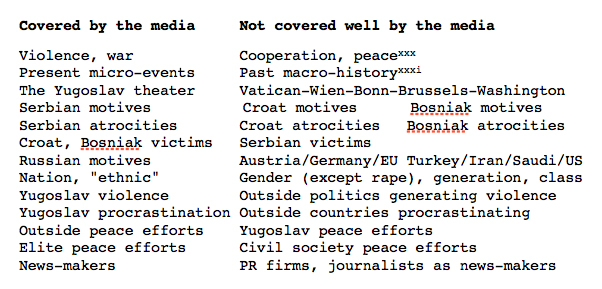
What did we typically learn from the media and what not during the 1990s? Here is one way of answering that question:

media

In the right column are a number of narratives, stories waiting to be told.  They are all important in any effort to understand what went on. But the media over-selected the narratives to the left at the expense of the narratives to the right.  The argument is not that what is to the left should not be covered, but that what is to the right should also have been given a clear voice, a ‘glasnost’. Thus, the role as “war correspondent” is classical and honored; peace journalism hardly even exists as a concept in violence-hungry Western media.

As a consequence the image created was that all bad events, with no history, just “nationalism”, happen in Yugoslavia. The idea of “ethnic conflict”, with no context in time or space, serves that purpose well. Outside actors are only spectators, trying their best to help in a noble way. This lack of historical context is what Professor Svetozar Stojanovic refers to as “presentism”. Good media would reflect all three, past, present and future (implications, consequences). [Read more…]